- Mental Health and Addictions Library
Mental Health and Addictions Library
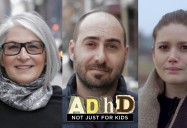
ADHD: Not Just For Kids
Width Height
Subject(s): Family Studies/Home Economics, Guidance, Health and Medicine, Social Issues, Social Sciences, Sociology, Special Education
Grade Level: 9 - 12, Post Secondary, Adult
It used to be just for kids, but not anymore. ADHD: Not Just For Kids aims to dispel the myths and stigmas about Attention Deficit Hyperactivity Disorder, a condition that many people, kids and adults alike, often live with for years, unrecognized or misdiagnosed.
ADHD is a neurobiological disorder that leads to inattention, hyperactivity, and impulsivity. People with ADHD are often the adventurers, the ones willing to take risks, and thus are an important part of our social fabric. ADHD: Not Just For Kids tries to show that children and adults alike can transform their ADHD from a functional shortfall into a strength. It just needs to be recognized in the first place.
ADHD: Not Just For Kids introduces the viewer to specialists and researchers who provide insight on current science and treatment. As well, successful adults share stories of attempting to cope for years with a condition they never knew they had, instead blaming underperformance and struggles with day-to-day functions, frustrated career ambitions, and problems with relationships, on laziness, lack of discipline or even lack of ability.
|
Running Time: 43:26 Country of Origin: Canada Captions:  |
Producer: Markham Street Films Inc. Copyright Date: 2017 Language: English |
Video Chapters
-
ADHD: Not Just For Kids 43:26
It used to be just for kids, but not anymore. ADHD: Not Just For...
TRANSCRIPT
Close- ADHD used to be just for kids, but not anymore. For some, it's a rude awakening.
- It wasn't like, oh, maybe I have ADHD. It was, I'm so anxious I'm going to die.
- What is life like for an adult with ADHD?
- I was feeling overwhelmed. None of the things that I tried were really helping.
- I'd be talking to him and he would just be like over there and like, there's a light, there's a thing. Samy, hey, I'm talking to you.
- Why are some I'm just finding out now?
- Every time I diagnose a child, I'm also generally identifying a parent who has it as well.
- If it's so common, why is it so misunderstood?
- I still hear, you know, well, how could you possibly have gotten to be a doctor if you have ADHD?
- Does this stigma keep us from finding the answers?
- Why won't doctors treat it? It's controversial. They don't want to get involved with stimulus medication.
- It's life changing to see the impact of that. It's profound.
- ADHD. It's here. It's real. And it's not just for kids.
- [MUSIC PLAYING]
- You know what, let's put a 24 mil on. Can he keep them on the truck or does he have to drop them off?
- No, he wants to drive then go.
- Did he look tough?
- He looked pretty tough.
- Background. And action. Samy Inayeh is an award winning cinematographer. He works in a high stress environment, making hundreds of creative and technical decisions a day.
- It's a beautiful day.
- He has a great eye, great instincts, and he has attention deficit hyperactivity disorder, better known as ADD or ADHD.
- Honestly, for me, it was like the last thing on my mind. I didn't think that I was ADD at all. I didn't really know that much about it. I just always associated ADD with like hyperactivity disorder in children, even thought, probably, that you grew out of it maybe as you got older. I just didn't know anything about it.
- One of the early myths, and there were many concerning ADHD, was that you would grow out of it.
- Dr. Russell Shachar is a psychiatrist at Sick Kids Hospital in Toronto.
- You don't see adults climbing on kitchen counters because they can't sit still. What they don't grow out of as they get older is impulsiveness or inattentiveness. So what you do often see when you're interacting with your adult friends is people who really can't concentrate on the conversation. They're restless individuals, without necessarily getting up and moving around. And adults develop a whole repertoire for hiding that.
- The symptoms can be managed if they get diagnosed in the first place. But many adults struggle for years with ADHD symptoms that have gone unrecognized or misread as anxiety or depression. This may be why Samy went looking for help in the first place. I was going through a particularly tough time in my life. And I started seeing a therapist for the first time. She was the one who sort of suggested that she thought I was very ADD and I didn't believe her at first.
- Then I started doing the research and I started reading about it. And it was like all the signs were there. So I decided to go in for a period of testing.
- ADHD is what, in medicine, we call a syndrome, which is largely defined by restlessness, inattentiveness, hyperactivity, and impulsivity. And when those symptoms occur together, we tend to make a diagnosis of ADHD.
- Diagnosis involves a checkup to rule out other possible medical causes of the symptoms. A comprehensive checklist developed by the World Health Organization helps identify key signs and symptoms.
- How often do you have trouble wrapping up the final details of a project-- [INTERPOSING VOICES] difficulty getting things in order when you have to do a task that requires-- [INTERPOSING VOICES] have problems remembering appointments or obligation? How often do you avoid or delay getting started? How often do you fidget or squirm with your hands or feet you have to sit down? How often do you feel overly active and compelled to do things like you were driven by a motor?
- Adults being assessed for the first time are also asked to provide a history of their behavior as a child. Looking back, Samy's ADHD symptoms now seem obvious. Symptoms like chronic procrastination.
- I was terrible at school, unless it's something that I'm really excited about doing I can make a million excuses why not to do it. And I was, yeah, I was terrible.
- Distractibility is another symptom.
- I would sit down in my class. I would open my notebook and I would start taking notes. 45 minutes later, I'd look down in my notes and I'd just written those two lines and I couldn't remember the last 45 minutes.
- Difficulty organizing thoughts or actions.
- I wrote essays that teachers would say like were the ravings of a madman. Like stream of consciousness. You know, and then the next thing you know, you're two months into the school year. And then you're six months into the school year. And you're behind and you just never feel like you can get out of it.
- ADHD sounds like an excuse. Doesn't everybody procrastinate, lose track of time, and forget things?
- The fast answer is that that's true. For example, we all procrastinate to a degree. We all sometimes get bored easily and sometimes we have trouble paying attention.
- Dr. Mayer Hoffer is a psychiatrist, an ADHD specialist in Toronto.
- It's not that hard to see when those aspects have entered into that realm where it interferes with your capacity to live the life that you're supposed to lead. In that sense, that's a huge distinction.
- ADHD can look a lot like normal behavior taken to extremes. So it can be easily misread. That can have an impact on relationships.
- Distractibility is a huge thing. If he's not on any type of drug, we'd walk down the street and I'd be talking to him and he'd just be like over there, and there is a light. There's a thing. And I would have to say, Samy, hey, I'm talking to you. Like, you know, stay in the moment.
- Sarah and Sammy are a married couple with a two-year-old son. They had just started seeing one another when he learned about his ADHD. The diagnosis made his behavior easier to understand and accommodate.
- Time was a huge thing. I would call it Samy time. Like I would always expect Samy to be at least an hour early if he was coming home. I just had to kind of adjust my expectations so that I wasn't always getting mad at him because I just began to understand that that was just the way his brain worked.
- The cause of ADHD has been narrowed down to the pathway in our brain that helps tell us whether a behavior is rewarding, like food or sex. Or something to avoid, like stress or danger. The transmitter that passes these chemicals signals from one neuron to the next is called dopamine. Ultimately, it signals receptors in the brain to stimulate our executive functions.
- Executive function is starting a task, staying on task, organizing materials, regulating emotion, very important one, and being able to use working memory, drawing on things in your past and applying it to the future.
- Dr. Ainslee Gray is an ADHD specialist and the medical director of the Springboard Clinic in Toronto. If you think of that prefrontal cortex as being like a symphony orchestra, and the conductor of that orchestra, when he's on the job, all the musicians are just playing beautifully. However, if that conductor checks out, the coordination becomes compromised. So we feel that the neurotransmitters that are feeding the conductor in our brain are insufficient in quantity or quality.
- What causes this shortage of neurotransmitters?
- There are two inches of the brain is the cortex. That's the highest, most evolved level of the brain. Then you have your millions of connections and neurons that make up your brain. And then it kind of funnels down towards the brainstem here at the base of your skull. In the brainstem, if you will, you have a beeping mechanism. It sends the signals from the brainstem, up through the brain substance, to the cortex to get the cortex up and running. When I'm like this, I'm sequential and logical and I can screen out distractions, external or internal. I can edit on the fly and be nimble in my thinking.
- What happens in attention deficit disorder, is you have a functioning brain stem. It's sending out signals all right. But these signals are on their way up to these particular areas are getting blocked or sidetracked.
- It may seem surprising that this hyperactivity disorder is generally treated with a stimulant.
- When you use a stimulant, half an hour later, like any self-respecting stimulants at the level of the brainstem, now instead of sending out signals like this, it started sending out signals like this, harder, faster, stronger, more frequent signals. These signals are going to go up. Some are still going to blocked or side tracked. But like water over the top of a dam, because there's more of them, these signals get up, over, around, under, through to these areas, transforming the this into that.
- So you get what's called the paradoxical response, the opposite intended response of using a mild stimulant. And a person, instead of becoming more hyper agitated, wacky, bouncing off the walls, talking faster, they become more focused, concentrated, organized, better able to acquit themselves well in their duties.
- ADHD affects about 4.4% of adults, but only a small percentage has been diagnosed or treated. How did the rest get missed? Some may have been treating themselves. Adrenaline is an effective way to increase dopamine. So high risk occupations like racing, firefighting, and emergency response are all magnets for thrill seekers with ADHD. There are many public figures with ADHD whose fame and fortune came with a healthy dose of adrenaline.
- Samy was fortunate to find a career that serves his ADHD well.
- That's my sweet spot. That's my comfort zone like when I'm on set. And there's always problems and things that crop up that you have to deal with and address like in the moment, make decisions on the fly. It's a pretty good job for somebody who needs something that requires them to hyper focus.
- The most incredible thing about Samy is he's the most calm presence on set. It's a total contradiction, in a lot of ways, to our home life.
- Every ADD person in the world can pay attention. In fact, they have the capacity sometimes to be able to hyperfocus on things that they're able to be interested in, ofttimes to the detriment of all the other things that they're supposed to be doing.
- What ends up happening is that you over work. So you're not trying to solve the problems in your life, you're actually ignoring it and you're using your work, because that's the thing you're good at, and that's where you thrive. And you're just sort of like disregarding everything else. And so you're miserable.
- The constant need for an adrenaline rush can be downright dangerous. It can lead to addictions to shopping, food, sex, gambling, drugs, booze, and especially tobacco. While 20% of the population in North America still smoke, for people with ADHD, it's closer to 40%, double the rate. What's going on?
- We were really struck by this ADHD smoking link, so that we wanted to know what nicotine can do in individuals with ADHD in terms of symptom reduction, and also what it can do in terms of emotional regulation.
- To learn more, Dr. Jean Gehricke launched a study of smokers who also took ADHD medication. But the study almost didn't get off the ground.
- It just seemed like there was nobody out there. They would either smoke cigarettes or take stimulant medication, but not necessarily take both.
- The volunteers they eventually found wore nicotine patches for two days and placebo patches for two days. Electronic diaries prompted them every hour to document their own ADHD symptoms. A blood pressure monitor kept track of physical activity and stress levels. The final data confirmed Dr. Gehricke's suspicions, nicotine reduces ADHD symptoms. That's because unhealthy as it is, smoking acts like many ADHD medications, it raises dopamine levels.
- This is what we're expecting to see. What was a surprise to us was that nicotine also reduced anger, nervousness, and stress ratings in individuals with ADHD.
- Teenagers with ADHD are twice as likely to take up smoking as their peers. And they tend to begin at a younger age. So what effect could smoking have on identifying ADHD in the first place?
- Nicotine use can cloud the recognition of ADHD symptoms in a way that the person may not remember having any ADHD symptoms whatsoever because he's continuously self-medicating with nicotine.
- 6 out of 10 Canadians who ever smoke have now quit. How many might have been self-medicating undiagnosed ADHD? Before he was diagnosed and treated, Samy occasionally smoked, and he found other coping strategies to get by. But they were never quite enough and things didn't get any better as he matured. They got worse.
- As you get older and you have problems, and you still have that same brain, and it's still got all the stuff that needs to get processed. And it goes on and on and on. And it's just-- it becomes crippling. It becomes crushing. And I'm not making any excuses, but you just start making really bad decisions. And in a way, your life starts becoming not a really great place to be.
- It's such a hugely important societal health issue, you know? Now if you're not able to compete in a tougher world, and ADD people fight harder and harder and harder to compete, it's a disaster for people.
- An adult with undiagnosed and untreated ADHD could be in for all kinds of problems with work and finances, relationships and marriage, substance abuse, eating disorders, unsafe driving, and problems with the law. Dr. Lynn Stewart is a psychologist who helps evaluate mental health programs in Canada's federal penitentiary system.
- So in 2011, we did a study on all incoming federal offenders to the Correctional Service of Canada. They were screened for ADHD. We found that 16% to 17% would have achieved a diagnosis of ADHD, and a further 40% would have had at least moderate symptoms of ADHD.
- It's estimated that 5% of adult males worldwide have ADHD. Why are the numbers so much higher in prisons?
- I think failure of self-control defines criminality, at least repeated criminality. And self-control problems are a major feature of ADHD. We found that those with higher levels of ADHD had more misconducts, more transfers to segregation, and on release, they came back to custody faster and at higher rates.
- As the result of the study, all incoming prisoners to Canadian penitentiaries are now screened for ADHD. Those who are diagnosed get streamed into therapeutic programs.
- I think it's critical to identify it and address it early. I hear sometimes from the offender, like, what is wrong with me? Why am I doing this? I think it would be helpful for them to know that and there's a way around that.
- Isn't ADHD already stigmatized enough? Is it really a go to jail card?
- I think it's important to say that most children who have ADHD won't go on to have a conduct disorder. And those who have a conduct disorder, won't go on to have anti-social personality disorder. But that almost everybody who has repeated criminal histories has had a failure of self control and probably would have earned an early diagnosis for ADHD.
- Is there a way to prevent ADHD? Some of the risk factors are out of our control, like family history.
- Every time I diagnose a child, I'm also generally identifying a parent who has it as well.
- And what role does gender play?
- ADD is like a big iceberg. And in that majority, underneath the waterline, most of those are women.
- Up next, ADHD, gender, and genetics.
- As long as you can remember, have you had difficulty getting organized? Yeah, absolutely. I've been a daydreamer, acted impulsively.
- Sarah and her husband Samy both work in the film business, juggling the demands of career, family, and ADHD.
- Felt irritable, had problems remembering appointments or obligations, fidgeted or squirmed with your hands or feet when you have to sit down for a long time. Yeah, that's my husband in a nutshell. And he still has some difficulty with some of these things even when he's on the medication. But with that said, like, I'm exactly the same way in a lot of ways. So it's very weird in that sense.
- We have to actually sometimes have to help each other. Then Samy's like, well, I think you're kind of a little ADD. And I'm like, well, am I? And where does it begin and where does it become like just like an actual condition?
- There's a big difference between personality quirks and a condition like ADHD. It was once assumed that ADHD was just the boys thing. That's likely because hyperactive boys are hard to miss. But girls and women can have it too, they're just sometimes harder to spot.
- By and large, girls tend to have a subtler presentation of ADHD. So not necessarily the daydreamer, but difficulties with focus, or attention, or distractibility.
- Doctor Laura Gerber is a pediatrician and ADHD specialist. I may be looking at you. You may think I'm listening to you. But you might not realize that I am totally focused on the buzz of the fluorescent light.
- There's a large population of girls who may have the attentive type of ADHD. And they're often the young ones that are at the back of a classroom. They're not bothering anybody. But they're tuning out. They're not learning optimally.
- When they talk about an iceberg and they say the largest part of the iceberg is the part below the water line, that's attention deficit disorder. Vast majority of ADD people are not hyperactive. And in that majority, underneath the waterline, most of those are women.
- For years, ADHD research focused mainly on males. The pool of research on females is slowly increasing. We now know that while boys tend to show symptoms by age 5, girls may not until age 12. And flying under the radar can have consequences later in life.
- Classic case of attention deficit disorder is the 19-year-old female university student. They go off to university and everything starts to fall apart. It doesn't fall apart because they're partying too hard or they're not mature enough or they didn't take their circumstances seriously. It's because for the first time in their life, the sort of external, exoskeleton of their life wasn't there. And then things didn't go well. And then they were left with this feeling of, not as good as everybody else. I'm not as smart as everybody else.
- And that young lady shows up at the University Health Service. And the psychiatrist will say something like, well, so tell me what brings you here. And the young lady says, well, I'm not doing very well. And the psychiatrist says, well, how do you feel about that? And the young lady says, well, not too good. And the psychiatrist then says, how long have you been depressed for? And in the first 45 seconds of the interaction, the psychiatrist has moved the young lady from what she's come for, I'm not doing very well, that's a function comment. And the psychiatrist has slid the young lady right into the psychiatrist's comfort zone, depression and anxiety, anxiety and depression.
- It's kind of stunning to me that a lot of people that I dealt with, different counselors and therapists, didn't notice this about me. It wasn't my psychiatrist's first instinct at all.
- For Medina Abdelkader, it was the pressures of grad school that revealed her ADHD.
- When I came to Toronto to do my masters, I was living by myself. So I didn't have that social support. And I had a really hard time staying organized. And I would go every single day and I would sit and I'd bring all my books and my laptop and my highlighters, and my good intentions. And I would just sit for hours and hours reading, going down the black hole of the internet and all these really juicy topics that I was studying. I just couldn't stay focused and I have all these ideas. And I just can't sit down for long enough to get them down.
- It wasn't like, oh, maybe I have ADHD. It was like, I'm so anxious I'm going to die. So I need to do something about this.
- Many successful people who are university graduates, they have professional careers, all of a sudden will hit a wall, a level of impairment, that results in their running into difficulties.
- Susan Gottlieb's ADHD managed to fly under the radar until her early 40s, thanks in part to her first marriage.
- There was a lot of structure in my life for those 20 years or so. But when that was over and things changed very dramatically and children came into my life, and there was no structure, there was no plan, it worked and then it didn't work. I felt from a functional standpoint that I couldn't do the kinds of things that I was always used to doing through just drive and willpower and intelligence.
- OK, listen, I won't keep you. But I just wanted to talk to you. I think we should be buying something here.
- Susan works for the investment arm of a big bank. She's a high achiever and good at her job. But ADHD can stay hidden until you reach a tipping point.
- And certainly being on an antidepressant, for example, which is what one doctor recommended, that maybe soothed my stress but didn't help me function better. And that's really what I needed to do.
- The medication is treating their mood or their anxiety, which is only a secondary symptom of the root of the problem being ADHD.
- Increasingly, both women and men have been discovering their ADHD in places like this, a pediatrician's office.
- So every time I diagnose a child, I'm also generally identifying a parent who has it as well. 95% of the time, that adult has not yet been diagnosed. So it's actually quite rare in my experience for an adult to say, yes, I was diagnosed as a kid.
- Yeah.
- Do you want this kind of spoon, Gracie, with your kiwi? Or the other kind? This spork thing?
- I'm somebody who has ADHD myself. I wasn't diagnosed until I was 31, so after I had finished medical school and residency. So a late adult diagnosis. All three of my children have it. And so I experience ADHD in the office all day long and I live with it myself. So it's something that is close to home, I guess you'd say.
- The tendency to develop ADHD can be inherited. But how does it start running in a family in the first place? Here in the Florida State Center for Brain Repair, they may have found the answer to this and other questions. To study a neurobiological disorder like ADHD, an animal surrogate is useful. Mice are good candidates. They share 97% of our genes. But how do you give a mouse ADHD? The same way that some humans get it.
- We knew from human studies that if a mother smokes, there is a higher risk of ADHD in their offspring.
- Smoking doubles the ADHD risk in humans. Dr. McCarthy and her team wanted to see if it had the same effect on mice.
- We expose a female miles to nicotine for three weeks. We can easily dissolve it in drinking water of the mice. And then she's bred with a naive male mouse. And nicotine is ongoing during her pregnancy. So the developing brain is exposed to nicotine from conception until birth.
- Once they're born, they get tested to see if any of them have ADHD symptoms.
- We break down each of the ADHD symptoms, like hyperactivity, inattention, impulsivity, and deficits in working memory. And we can test each one of those using our animal model.
- To test for deficiencies in learning and working memory, McCarthy uses this Barnes maze. It's a platform beneath a bright light and a noisy, clattering fan. There are 40 holes that a mouse might use to escape the light and noise. But only one leads to a quiet hide out under the platform. There are visual cues to help orient the mouse. For a normal mouse, it takes about two weeks of daily training to learn and remember the fastest escape from the noise and light.
- This mouse has been training for just as long, but it's showing all the signs of ADHD. It covers a lot more ground, wastes more energy, and makes more mistakes, but remarkably it finds the escape hole in the same amount of time as the normal mouse.
- For us, that's most interesting. It's not that they cannot learn the task, it's that they have a different way of learning it.
- To test for impulsivity, they use the bar stool.
- We call it a bar stool because that's basically what it looks like. And normally what a mouse will do, they'll go to the edge of the platform and they'll sniff around and get used to that environment. But mice that we have found that we're calling ADHD-like or impulsive-like well it tends to sniff, put their nose over the edge a lot more frequently than the normal mice. And they actually jump off.
- After testing the mice whose mother was exposed to nicotine, how many are they finding that acquired ADHD?
- Every single mouse in the litter had ADHD-like symptoms. Every one of them.
- But it doesn't end there. McCarthy and Dr. Pradeep Bhide have uncovered disturbing new information about ADHD heritability.
- Some research we have now done that shows that the effect of prenatal nicotine exposure actually can be seen in multiple generations. In the '30s, '40s, and '50s, cigarette smoking was highly prevalent. In fact, some physicians would advise pregnant women to smoke cigarettes to deal with morning sickness, for example. So it's a sobering thought, I think, that we may be seeing some of those effects in the current generation.
- There may be a smoker generations back who has increased the ADHD odds in your gene pool. Could this be a permanent threat?
- Luckily, smoking is declining. So perhaps two or three generations from now we may not see the effects of cigarette smoke exposure. However, there may be new environmental toxins or environmental stimuli that may produce these transgenerational effects that we don't even know about today.
- The search for new medical treatments for ADHD is part of a multibillion dollar industry. But there's an ongoing search for non-pharmaceutical solutions too, using coaching, behavior therapy, and even gaming.
- Contrary to what we thought, we actually make new neurons. You can teach old dogs new tricks.
- Next up, pills and skills.
- Whenever ADHD is mentioned, there's usually discussion about the medications, and reluctance to use them.
- So when I see patients in my office say that the problem that you have has squat to do with illness. It has everything to do with function. No different than why a person wears glasses. You have a functional problem, you put your glasses on. It allows your perfectly healthy eyes the opportunity to operate at the peak of their intended biological capacity. All I'm going to be trying to do is put a pair of glasses, as it were, on the inside to allow you're perfectly healthy, smart, capable brain the opportunity to operate at the peak of its biological capacity.
- These glasses for the brain are stimulant medications. They've been the gold standard for ADHD treatment for more than 50 years. So there's good evidence they're safe and effective for adults and children. But the increase in the number of children identified with ADHD in the past decade has set off alarm bells about the potential harms of over-diagnosing and overprescribing, especially in the US, where the percentages are the highest.
- But treatment doesn't always end with meds.
- At the end of the day, you need to have good executive functioning skills. And medication isn't going to do that for you. It'll help you acquire those skills more easily. But it's not actually going to give you those skills.
- Here at Sick Kids Hospital, Dr. Jennifer Crosbie has been testing new therapies for ADHD one executive function at a time.
- There's a number of different kind of cognitive processes that fall under this umbrella term of executive functions. One of the domains that we started with was response inhibition. Can you stop what you're doing quickly based on new information in your environment?
- Let's say you're driving along at a reasonable speed, and a ball comes out between two parked cars. That's when that ability is invoked.
- It takes an ADHD person about 150 milliseconds longer to respond to a prompt, the difference between a hit and miss.
- You're out.
- Let me just get us logged in here. All right, so sometimes you're going to see this. And what that means is a signal for you to stop, OK?
- The mega team project is a video game-based cognitive rehabilitation. So what we have done is we have taken our understanding of the underlying cognitive deficits in ADHD to come up with an intervention to strengthen those. And ideally what we've tried to do is come up with something that's engaging and fun for kids.
- There you go. Excellent.
- Mega team was co-developed by Sick Kids and Ehave, a medical software company founded by Scott Woodrow. Scott has a vested interest. His son has ADHD.
- And that's one of the main reasons why I did this. I didn't want to medicate my child. The medication deals with the symptoms of the condition. It doesn't deal with the underlying condition itself. When they're off the medication, their condition comes back.
- 50 kids have been recruited to try to sharpen their response inhibition skills. Progress is monitored online. Later, there will be a follow up to see if the training had a positive effect on behavior beyond a quicker trigger finger.
- This ability to stop a speeded motor response is what you need to keep your mouth shut when you have any impulse to say something or keep your hands to yourself when you have the impulse to do otherwise.
- Future plans are to build the game out to target other cognitive functions and to test if it can help adults as well.
- Neuroscientists have discovered over the last few decades that we actually, contrary to what we thought, make new neurons even in late age. So we have the capacity to change, rewire, you can teach old dogs new tricks. I'm thankful for that. I'm living proof of it.
- The stakes are high in the games played here at the epicenter of Canada's financial district, world markets, breaking stock reports, and investment analysis. Susan Gottlieb is plugged into it all.
- It uses all my skills and keeps me excited about going to work every day. That's why it was so frustrating for me when things weren't working the same way.
- Susan's symptoms improve after being diagnosed and treated for ADHD. But she felt she needed more.
- The medication, I think, prepares the way. It gave me hope that maybe I could solve these problems. But I still didn't know how.
- Many business people turn to executive coaches to help improve their performance. Susan went to Robert Pal, a coach who specializes in ADHD.
- So let me ask you, can the rest of your company survive without you for two hours?
- Oh, without a doubt.
- Without a doubt. OK.
- Yeah, that email is just--
- It's addicting.
- It is. It really is. Between the phone--
- There are pills that can help. But it's a behavioral change. And it's hard because it's a lifetime of responding a certain way. What's the most important thing you have to do?
- I have to call clients, review portfolios, that type of thing.
- So when I'm hearing you say that, I'm getting overwhelmed. I'm sure you have hundreds of clients with some very complex portfolios. But the key is, to stop the feeling of being overwhelmed, is you want to break it down into specific behavioral stuff.
- OK.
- Do you remember what it was that gives us a 300% greater probability of success?
- Yeah, I got to book it.
- You got to book it.
- I got to book it.
- Do you have your phone here?
- I always have my phone.
- All right.
- The best approach to treating ADHD is three pronged. One, is they need to learn new behaviors in order that they can function better. Number two is the pharmaceutical treatment. And number three is some emotional support.
- On the personal side, it really has to be about my family and being with them, being with the girls. I've got to use the time more productively so that I'm not there at the office at night.
- So the motivation for reserving this time is, besides for helping your clients, it's allowing you to spend the time with your kids.
- Yeah.
- That's great.
- Yeah.
- Sounds very motivating for me.
- Very much so. This is very practically how I can change my thinking, how I can learn, and how I can repeat these steps for all of the things that are going to come up in my life and come up on a daily basis. I now have the tools. And they help me in every part of my life.
- Life after ADHD diagnosis.
- It's not like I was able to get this treatment and now I'm cured. But having that awareness just helps me to forgive myself when I'm not perfect.
- I wouldn't want to get rid of the ADHDers. I think it's wrong to think that everybody has to have an even keel. I think there's room for everybody, right?
- The final stretch, staying on course with an uneven keel.
- Math challenge, you didn't do the bonus.
- Look at this.
- It's not--
- Bonus for anyone who wants to try.
- OK, it won't hurt you to try.
- She's a busy mom, a pediatrician, and she has ADHD.
- I still hear, you know, well, how could you possibly have gotten to be a doctor if you have ADHD? But the reality is, it has nothing to do with intelligence. There's lots of successful people out there who have it. But that perception is still there. So in summary, we just wanted to kind of wrap up by saying that ADHD is not just about the DSM checklist and that it's both exciting and exhausting.
- In what little spare time she has, Laura Gerber also gives seminars to other medical professionals about the signs and symptoms of adult ADHD.
- I mean, it came from a place of frustration. It was intimidating. I won't lie, because I know that there's a lot of them that have those outdated views that it's a childhood illness. And they've been skeptical about whether it's an issue for their adult patients and the parents that I've sent back to them. I've been very pleasantly surprised how well people have responded.
- Medina Abdelkader found help for her ADHD, medication and movement. As a sport, rowing is incredibly technical. So I find that with other types of exercise, I can kind of zone out. But you can't with rowing. When you do, bad things happen.
- Keep your shoulders still.
- There was such a difference between pre-medication and post-medication. And so what that helped me to do is sort of explain to myself what's going on and just kind of forgive myself for when it doesn't go perfectly. Because I'm like, OK, this is not me failing, necessarily. This is just one aspect of my life that I have to work on. And the medication helps with that. The exercise helps with that.
- Four months after we first met Sarah and Samy, Sarah went to a specialist and confirmed what they had suspected for a while, Sarah has ADHD.
- Yeah the first thing I did was I called my mom and I just cried. Because I was like, it's been hard. My life has been hard. Like, it's great now, but it's been hard. And I never quite understood why it was so much more difficult for me than other people.
- Can you show us how you can run?
- Before we even knew that I was ADD, I think, we always knew that there was a really good chance that Cleo would be. We don't have any intention of really doing anything about it at the moment, other than just encouraging him, and loving him, and watching him develop. I think we'll just take it one step at a time.
- I think it's wrong to think that everybody has to have an even keel. World is made up of a lot of different people. I wouldn't want to get rid of the ADHDers because very often they're charming, and they dabble. They try different things. They're adventurous. And I think it would be a loss if we started to temper that too much.
- An ADHD brain struggles with many challenges. But when it's treated and managed, it's a brain with a unique perspective on the world. It just has to be recognized in the first place.
- [MUSIC PLAYING]
TRANSCRIPTS:
Interactive Transcript
Transcript (PDF)